Wednesday, May 1, 2019

Getting settled

I wake up and sleepily check the time. 5:30! It's the morning of my move, and I've slept later than usual. The sun is already rising.
I shower and dress for my last breakfast at Mafumu Lodge, very happy to again eat out on the patio by the garden.
When I return to my room, I realize how little I need to do to be ready. Why not relax for a while, read, review my photos? I have time.
The ring of the room's phone surprises me. My first thoughts are of all of my family and friends in North America, but then I remind myself that there are people here who already know me and may need to reach me.
"Hello?" I answer. "Good morning, madam," a woman's voice replies. "Your taxi is here." "My taxi!" It is only 8:00, and I hadn't expected to be picked up until 10:00. "Okay, tell him I'll be ready in ten minutes," I say, reflexively accommodating.
I hang up and look around. I haven't even started to get ready. And Marine isn't expecting me yet. What will happen if I arrive at Savanna Courtyard two hours early? She might not even have the key to our flat. Why am I rushing?
I pick up the phone and call the number for reception. The woman's voice answers. "Could you please ask the taxi driver to come back at ten o'clock?" I ask, feeling both relieved and proud. I am not just a passenger or something to be transported, as I've felt so often in the past few days. I am an active agent!
Before 10:00, I am packed and begin to take my luggage to the parking lot. One of the men on staff sees me and comes to carry my bags for me, scolding me laughingly for trying to do it myself. Not tipping him feels awkward, but apparently that is how it's done here. In any case, I don't know what amount would have been insulting, and what would have been too much. Refraining seems simpler. 
Weeks later, I read about a Nigerian woman's reaction to tipping in the United States; how every time she does it, she feels like she's paying a bribe. I laugh, recognizing my experience through the looking glass.

A new home


When I arrive at #10 Savanna Courtyard, Marine is waiting outside to greet me. "I just got the key now," she says. "When I knocked on the landlord's door, the man who works for him answered. He asked me to come back later — I think Faheed was still sleeping, and he didn't want to wake him — but I told him you were coming with your things, so we needed the key now. If it had been just me, I'm sure he would have made me wait."
We're both very happy to finally get settled. 
Our white, solid wood front door opens into a large, open living space. On the left is a living room with a simple couch, two matching arm chairs, four end tables, a coffee table, a television, and a desk. On the right is the kitchen and dining area. We have a small stove, or “cooker” as it’s called here, a small refrigerator, black wooden table and chairs to seat six, a short pantry shelf, and a small, plastic washing machine.
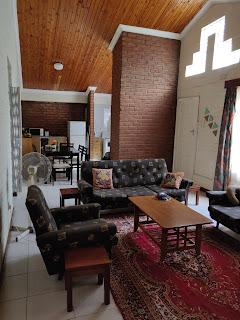


All the walls are brick, most of them painted white. The high, peaked ceiling is made of varnished wood with black caulking running through the join at the top.
The middle of the back wall opens into a short hallway that leads to bedrooms on the left and right. Each bedroom has its own small bathroom with a tiled, concrete shower, toilet, and pedestal sink. Marine takes the bedroom on the left with a queen-size bed and white mosquito net. I take the one on the right with two twin beds, each with a blue mosquito net. With a couple pillows against the wall, one bed becomes my “couch”, and will be a guest bed when I have visitors.


Although our new home looks simple to me,  Marine tells me how much cleaner and better equipped it is than the flat she was sharing with Jonathan. The next day, our colleague and neighbour Chenai drops in after church and confirms this with her exclamations. "You have headboards," she exclaims, "and your walls are so white!" "Our cooker elements aren't just either off or on high, like the one in the flat I shared with Jonathan — they actually adjust their temperatures,” Marine tells her. Until hearing their comments, I hadn't even realized that these were things for which to be grateful.

The market and Chipiku

Since neither of us have much, unpacking only takes a couple hours. Once I'm done, my thoughts turn to groceries. "How do I get to the market from here?" I ask Marine. "I've only been there once," she says. "Why don't you ask Jonathan? I bet he would take you."
I collect my wallet and shopping bags, put on a cap and some sunscreen, walk up the row of flats to #7, and knock on the door. "Marine suggested I ask you to show me the way to the market," I tell Jonathan. He looks mildly surprised, but goes to get his things, and very shortly comes out to join me. 
Jonathan is in his late twenties, a lean, quiet man with a slight slouch, full lips, a square jaw, prominent brow, light brown hair, and a receding hairline. From his usual silence and thoughtful expression, I've already guessed that he's an intravert. He seems friendly when he does respond; he’s just someone with a rich internal world who prefers his own company.
Six guards are lounging on the lawn inside the gate. They greet us, and one of them gets up to pull back one welded black geometry of squared iron bar so that we can exit. 
We cross the road, and Jonathan leads me along a red dirt path that skirts along the thatch fence of the brick house facing Savanna Courtyard. The path angles onto another street.


Trees shade the roads, and birds call to each other above us. A few other pedestrians are also going somewhere. Once in a while, someone in a car or on a bicycle passes. We step down packed dirt steps held by tree roots, step across a deep ditch with brick sides, cross the road, and walk pass the 24-hour clinic that seems so out of place to me in this quiet neighbourhood.


We turn again, walk down another quiet street, and here we are amidst cars and shops and people. The smell of mandasi -- thick, dense doughnuts of fried bread, slightly sweeter than bannock, and sold out of plastic pails by vendors on the street -- greets my nose.

Mandasi vendor

I notice a National Bank, and we pause so I can withdraw money. Across the street from the bank is a large and busy mall, circled by sidewalk. We walk past it and beyond the sidewalk, along the side of a busy road, and then into the embrace of the market.


Shops on the street side of the market

We are surrounded by wooden stalls displaying fruits and vegetables, vendors seated at each one. People are milling about, and I breathe in the warm, musty scent of people's bodies as they pass me. I haven’t inhaled this much body odour since gym class in high school, and I’m surprised to find it’s not unpleasant.
I haven't eaten since breakfast, and everything looks delicious. As soon as I stop to admire some green beans, I'm surrounded by young men eager to sell me their produce. I select a few things — a papaya, a package of small ginger bulbs, a little plastic bag of powdered turmeric, carrots, sweet potatoes — and they call out prices. I'm trying to do one thing at a time, but all of them are handing me things and talking at once. I pack my purchases, dole out kwacha to them, pick up my weighty bag, and turn to find Jonathan at my elbow with a small, black plastic bag of his purchases.
On our way back past the mall, I see that there's a Chipiku Plus, which Marine had recommended for anything I couldn't get at the market. I tell Jonathan I'd like to stop there, and he looks reluctant. "That's okay," I say. "I think I can find my way back from here." So he walks on without me, and I turn to go to the store.


A security guard stands at a wooden pedestal in the middle of the entrance, stamping people’s receipts as they exit, and several men are mopping red dirt off the white floors. The aisles are much busier and the produce section better stocked than the Spar store Marine took me to at lunchtime a couple days before. I find one shelf with bags of dals, cumin, bay leaves, kokum, and tamarind, and am reminded of the shops I used to frequent in Vancouver on Fraser Street. A few rows down, there are boxes of the delicious Kenyan tea, Kericho, to which my dear friend Rahel introduced me. And I'm thrilled to find soy milk — I had little hope of getting it here after seeing only dairy milk in plastic bags and tetrapacks at Spar — and peanut butter with no added sugar. They even take Mastercard, so I pay with credit, avoiding the still unfamiliar currency.

Finding my way

Well-burdened now with both a backpack and large grey fabric grocery bag, I begin the walk back home. I recognize familiar landmarks — the bank, the tourist market stalls, a gas station on the corner — and am proud of myself for this early independence. It's 28°C, the groceries are heavy, and although Marine had said the shops were only a couple kilometres from our home, the journey seems longer. 

After walking up a short hill, I reach a T-intersection. The 24-hour clinic is on my left, so I turn in that direction. But once I pass it, I'm unsure where to go. A road branches off to the right, but the gates and walls of the residences look too wealthy to be our street. Further down, there's another T-intersection, but when I get there, I'm not sure which way to turn, or whether either way would take me home. I thought I would be able to see our gate from here, but nothing looks that familiar.


On the corner across from me, two men are roasting and selling corn. I walk across to them and ask whether they know the way to Savanna Courtyard. They are friendly, but unable to help me. I approach a couple women walking past, but although they respond affirmatively, it soon becomes apparent that they, too, don’t know.
Still hungry, I decide to just take a break and treat myself to a cob of roasted corn. It’s only MK100 ($0.18). I walk back up to the first turnoff and sit down on the grass in front of one of the housing compound walls.
I’m disappointed to find the corn is crunchy and starchy, not sweet and soft as I’d expected. I’m reminded of corn kernel snacks I’ve had before, but, not having oil or salt, this is much plainer.
A couple with a well-used white Toyota Range Rover is also taking a break nearby. We strike up a conversation. They are waiting to look at a flat for rent in one of these housing compounds. The woman, Angela, has just gotten a job in Lilongwe, and they’re moving into town from the village where they’ve been living. After we’ve talked for a while, they invite me to see their sleeping three-year old daughter, lying on the backseat of the Toyota.
Having eaten and rested, I finally give up any pretence of independence and call Marine. “You’re almost here,” she says. “Go back to the T-intersection, turn right, and then turn left at the fork in the road. Savanna Courtyard is the first gate on the left.”

What I’ve learned about getting lost is that it can be very helpful in really getting to know the way.

Copyright © 2019 Lynn Thorsell, All rights reserved.


~ * ~ * ~ * ~


Please note that the views expressed here are mine alone, and do not necessarily reflect the views of Cuso International.

Saturday, April 20, 2019

Shifting context


Photo courtesy of Mafumu Lodge

It’s 6:00 p.m. when I get back to my hotel room Thursday evening. I’m tired from the long first day in the office, uncomfortable from the heat and the persistent post-flight swelling in my hands and feet, but I’m also hungry. I have the refrigerated block of smoked tempeh that’s traveled with me from Vancouver, and the package of local carrots I bought during the lunch break. As tempted as I am to eat the carrots raw, the traveler’s food preparation mantra is fresh in my memory  Peel it, boil it, cook it, or forget it.

Rather than risk illness, I decide to tackle the carrots on several fronts. First, I scrub each of them with a nail brush. Then I scrape them as best as I can with my Swiss army knife. Finally, I place them in the sink and pour a kettle of boiling water over them, then let them sit for five minutes. Cold tempeh and parboiled carrots make a simple dinner, but simple seems to agree with me right now. The whole procedure takes enough time and energy that by the time I finish eating, I’m ready for bed.

Despite getting a good sleep, I wake up the next morning still feeling tired. When I go to the restaurant for breakfast, I find one of the staff unsuccessfully trying to open the French door entrance. He directs me to another door to the side of the building, and I enter there. After getting my breakfast, I find the doors to patio are also locked, and that no one has the keys to the restaurant doors today. I choose a table inside and settle down to eat. 

Photo courtesy of Mafumu Lodge

Al Jeera news is again playing on the restaurant television, which is how I learn about the shootings at the mosques in Christchurch. The horrifying story with brief updates is repeated over and over again. Yesterday I learned from others in the office that a cyclone has flooded and destroyed thousands of homes in Mozambique and in southern Malawi, and that hundreds of thousands of people have been displaced into emergency relief camps and are at risk. Members of the CARE team, including Laurent, the Cuso volunteer for water and sanitation, had already begun planning and preparing their deployment to that area. As I watch this morning, I see mention of this unfolding humanitarian crisis cross the bottom of the screen, but it’s clearly overshadowed by the violent drama that’s just taken place in New Zealand.

My second workday

At the office, many of senior leaders and staff involved in water and sanitation are busy with emergency response preparations. Meanwhile, I continue digesting the SANI baseline report. While I’m reading, I keep asking myself whether there’s any way I could offer to assist with the response work, but being so new here I have no clear ideas about how I could help. The CARE team seems well organized, and I decide that if they needed unskilled labour, they would ask. I’m also not sure that I’m emotionally prepared to be immersed into emergency relief camps so early in my time here, and while I’m still figuring out how to take care of myself. I may be more of a liability than an asset.

Marine interrupts me to let me know that she’s getting the keys for our townhouse from the landlord tomorrow morning at 10:00, and that Clement is arranging for a taxi driver to bring me over then so that we can both move in. Six weeks after moving out of my apartment, I’m looking forward to finally unpacking my suitcases and getting resettled.

Ground floor view from CARE office building

I’m relieved that CARE staff end their workday at 1:30 on Fridays. Hot and ankles still swollen, a shorter day is long enough for me. Towards the end of it, Clement comes over to let me know the driver is ready for us, and tells me I look very tired. I’m grateful to finally return to Mafumu Lodge.

Small luxuries

Since I have the afternoon to relax and this is my last day at the lodge, I decide that I’ll treat myself to dinner at the restaurant tonight and spend the afternoon outside. When I arrive at the lodge, I walk over to the restaurant to review the menu. Although most of the items are not to my taste, they do feature a Greek salad: “The Classic!” it exclaims. The thought of fresh cucumber, tomato, bell pepper, and oregano along with plump olives and salty feta already has my mouth watering. And the price is MK4,000, which converts to $7.20. I have enough cash, and since that seems relatively expensive, I think the salad must be substantial enough to form a meal.

Next, I go to the office to pay for my last night. I ask whether someone could help me open my patio doors, and one of the women at the desk accompanies me back to my room. She seems amused by my request, and is surprised when she finds the doors are more difficult to open than she expected. After making sure they’re unlocked and then shifting them in their frames, she finally manages to free them.

With a book, my water bottle, and the left over tempeh and carrots, I settle myself on the the tiny patio outside my suite. Other than a few hotel staff and a couple drivers working and talking in the parking area, I’m the only person outside. The patio doors of all the other rooms are closed and draped. The air is warm, the vegetation is lush, and after three days of travel and one and a half days at the office, the luxury of having time to just relax is absolutely delicious.

Photo courtesy of Mafumu Lodge
Very soon, though, I start to feel sleepy. By 3:30, I can barely stay awake. In fact, I’m tired enough that I don’t trust myself to wake up in time for dinner. I set an alarm, and by 4:00 I’m fast asleep.

The alarm wakes me two hours later. It’s twilight. I’d been sleeping deeply — could have kept sleeping all night, perhaps. For a while I consider doing that, but the thought of the Greek salad motivates me to rouse myself, get cleaned up, and dress for dinner.

When I arrive, the only other diners are two men just finishing their meal. The restaurant closes at 8:00, so I expect people here eat early. As I wait for my dinner, I reflect that a salad was not the safest choice. The ingredients are unlikely to have been peeled, boiled, or cooked. I question my selection, but decide to take my chances.

I read while I’m waiting, and look up with anticipation when the waiter brings my order. A few lettuce leaves form the base. Spread on top of these are many slim slices of red onion, shavings of green pepper, a few slim and decorative slivers of seeded tomato, a sprinkling of canned black olive slices, and half a dozen small cubes of feta, drizzled with balsamic vinegar. Nary a hint of oregano greets my mouth.

It’s disappointing, but at least it doesn’t make me sick.

Copyright © 2019 Lynn Thorsell, All rights reserved.


~ * ~ * ~ * ~


Please note that the views expressed here are mine alone, and do not necessarily reflect the views of Cuso International.

Friday, April 12, 2019

First day at the office

Clement the program manager for the Southern Africa Nutritional Initiative, or SANI Project, is about my height, slimly built, 36 years old, with a broad face and friendly countenance. He greets me warmly when I arrive at the office, gives me my orientation plan, and shuttles me around to introduce me to the other SANI team members. Once we've done that, he takes me to my first meeting. 

Catherine, the assistant country director, a petite woman of about 40 with short, straightened hair brushed back from her face, provides me with a security briefing. Motor vehicle accidents are the biggest hazard, she tells me, so they have strict requirements for their drivers to stay within restricted speed limits. (Motor vehicle accidents are also the most common cause of traumatic worker deaths in British Columbia.) Pickpockets are prevalent in crowded areas, such as markets. And, as one young volunteer recently discovered, if you leave your laptop in a vehicle, it will get stolen — “As it would in Vancouver,” I laughingly reply.

The CARE Malawi office building

She tells me that it’s safe for me to travel anywhere in the city on my own during the day. After 6:00 p.m., however, if I’m outside my housing compound, then I should be with friends or colleagues and have a car or taxi. And while any business-appropriate clothing is acceptable in the cities, dress is more conservative in the villages, and if I go there, I will want to take a chitenje (the local version of a sarong).

Then I meet with Matthew, CARE’s country director, a lean, white British man, about 5’10” and in his late 40s. He’s warm, friendly, and interested in my background and experience. He was promoted last year to the role of director for the East, Central, and Southern Africa region, but hasn’t yet been able to hire a new country director due to funding shortages, so is performing both roles. Over the next few weeks, I’m impressed to observe that, despite the volume of responsibilities he’s managing, he maintains his warmth and interest in people, even though Cyclone Idai has caused he and his staff have to shift their focus and resources to respond to that emergency.

Basic amenities

Of course, eventually I also have to take care of my biological needs. The two washrooms in the third floor office have solid, brick orange wooden doors with symbols for man or woman painted in white on them. When I enter the women’s washroom, I find there is no hydraulic arm to soften its closure. I am frequently at risk over the next few days of banging it much more loudly than intended. 

Inside, there are two stalls with full wooden doors painted the same brick orange. On the insides of these doors are Deloitte posters for reporting ethics issues. The posters list contraventions in English in one stall, and in Chichewa in the other. 


Paper towel for drying hands is on a wide roll suspended from a simple metal stand beside the sink. When I try to use it, I find that it’s as thin as toilet paper and sticks to my hands. After trying this a couple times during the day, I decide that there are better uses for wet hands. From then on, I begin using them to dampen my swollen ankles, and to cool my sweaty neck and brow.

One-ply paper hand towel

A walk to the store

When we break for lunch, Marine takes me to the Spar grocery store. I want to be frugal while I’m staying at the hotel, so have decided to eat the groceries I brought with me rather than buy meals there or at a restaurant. Today I have dates and almonds for lunch. Back at the lodge, I have a block of smoked tempeh that will be enough for two meals if I supplement it with a vegetable.

Turning out of the office parking lot, Marine takes me for a walk along a dirt path through many trees. Here and there are clearings where people are eating lunch at benches beside outdoor barbecues or small wooden food trailers. I wonder what they serve there.


We come out onto a street with a small National Library building and a DHL Courier office, walk down another short street, and cross a busier road into the parking lot of the Spar grocery store.

When we enter the store, a display of green apples is the first thing I notice. I’m surprised, since apples are the one fruit I did not expect to find here. Both local carrots and carrots imported from South Africa are in the open produce cooler along the wall. I choose a package of the less perfect but fresher looking local ones. 

What strikes me as I wander through the rest of the store is that although all the shelves are full, there is very little variety compared to a North American store. Instead, there are rows and rows of the same types and brands of items — of Chombe tea, ACE instant porridge, and either Estrell or Rab’s Classic peanut butter.

A long day

Workstations at CARE Malawi
During the afternoon, I sit at one of the long desks amongst my new colleagues and begin digesting the baseline report for the SANI project. It outlines the research done in four villages to assess lifestyle, diet, gender relationships, and levels of malnutrition and stunting. It’s a long and detailed report, and also my first glimpse into the districts and communities with which this project is engaged. 

While there had been gradual improvements in the previous ten years, when the baseline data was collected in 2016, 38% of children under five in the villages being studied were stunted. Almost 5% of pregnant women and 4% of children under five were acutely malnourished, and 93% of the children were not receiving a minimum acceptable diet (frequency and variety of foods). Their parents fared little better. At the time of the study, people’s diets predominantly consisted of maize and the leaves of pumpkins, sweet potatoes, and other crops that they were growing. Less than half of them would have eaten any other fruits or vegetables, and at most only 25% would have eaten any higher protein foods such as legumes, meat, eggs, or dairy products.

The office is hot, and although I’m sitting beside an open window and have my feet propped on the ledge, the heat has increased the post-flight swelling in my hands and feet. Our workday ends at 5:00, but Jeremy, who was scheduled to drive us, is out running an errand. We work for another half hour before someone arranges a taxi to take us back to Savanna Courtyard and the hotel. I already feel like it’s been a very long day.

Copyright © 2019 Lynn Thorsell, All rights reserved.


Please note that the views expressed here are mine alone, and do not necessarily reflect the views of Cuso International.

Monday, April 8, 2019

Morning

I wake up at about 4:00 a.m. Lying in bed, I hear a man’s voice in the distance begin singing a gentle but penetrating chant in another language — the morning call to prayer. This is the first time I’ve ever heard it. It is, indeed, beautiful.


I get up and do a few exercises on my new yoga mat. My hands and feet are still swollen from the flight, even though I slept with my feet raised on pillows. I hope that the exercise will help relieve that. As the sun rises, I start to hear birds — chatty, melodious, querulous, proud, insistent — a small orchestra of sounds. Some, like the doves and roosters, I recognize.

When I arrived at the hotel, one of the first concerns I had was whether I could drink the water. I found a small bottle of water in the little fridge, so drank that to start. But I absolutely don’t want to be reliant on bottled water while I’m here, and I have no idea whether the tap water was safe for me to drink. What is the alternative? Before I went to bed, I boiled tap water in the kettle, put it in my water bottle, and left that in the refrigerator over night. I’m grateful to have that this morning

(Later I learn that while tap water in Lilongwe is chlorinated, there was a contamination problem late last year, so boiling it is still advised.)

After getting dressed for my first day of work in Lilongwe, I walk across to the restaurant building and enter through open French doors. There to greet me are two women standing behind a table with hot serving trays and a griddle for cooking eggs. On another table against the adjoining wall are coffee, tea, and covered platters of cold food. 

I’m pleased to discover slices of papaya and watermelon, and also get two fried eggs with baked plantain and a few pieces of roasted potato. I take my breakfast through the simple dining area where other guests are eating and watching a news broadcast, and find a table on the patio facing the garden. Another man is seated at the table next to me, absorbed in reading something on his laptop as he eats. A laptop case, open briefcase, and stack of papers suggest he’s here on business.


I was told to expect someone to pick me up at 7:30, but when I come out to the parking area at 7:20 with my briefcase, ready to go, a very friendly man approaches me, introduces himself as Jeremy, and tells me he’s been waiting. Am I late? This is not the Africa time I expected! I go to get into the passenger seat of the Toyota Land Rover, but find (as I did at the airport) that I’m on the driver’s side. Jeremy laughs, and asks whether I’m ready to try driving here. I grin, and I walk around to get in the other side.

Jeremy drives down a couple well-treed streets, skillfully dodging the potholes, past a long brick wall with “Korea Garden Lodge” painted repeatedly along it, and pulls up to a gate in another brick wall. He honks for the security guard to open the gate, and we drive into Savanna Courtyard, pulling up to the first in a row of small, red brick townhouses. Jeremy honks again, and Marine and Jonathan, the other Cuso International volunteers working at the CARE office, emerge from the house to join us.

Jeremy parked outside Flat #7, Savanna Courtyard

Savanna Courtyard is two rows of brick townhouses in an L-shape set on one side of a circular driveway, with a large brick house in the middle. The first row of townhouses, on the left as we drive in, are one-story two-bedroom dwellings. Those along the row at the back are larger two-story units, each with a small balcony on the second floor. Outside each townhouse is a dark green or blue water tank atop metal scaffolding. There are rough, crabgrass lawns and many trees. Somewhere in this complex is the townhouse where I’ll be living.

Copyright © 2019 Lynn Thorsell, All rights reserved.


~ * ~ * ~ * ~


Please note that the views expressed here are mine alone, and do not necessarily reflect the views of Cuso International.

Sunday, April 7, 2019

Mufumu Lodge


The security guard opens the large, metal gate to Mufumu Lodge, and McNaughton drives us through, parking in front of a set of six long, parallel one-story buildings, each a row of suites. Mufumu means "chiefs" in Chichewa, so this is Chiefs' Lodge, McNaughton explains.

The office at Mufumu Lodge

On the other side of the driveway are two buildings, each the size of a small one-story house. One of these is the restaurant, and the other is the office and laundry. The simple buildings let the surrounding lush, well-groomed greenery take prominence. Lawns, trees, and green gardens fill the rest of the grounds.

One of the hotel staff comes to unload my suitcases from the trunk and backseat of the old blue Toyota Corolla. I walk over to the office to check in, unsure what arrangements have been made, and hopeful that CARE or Cuso have already paid for the room. Unfortunately, that is not the case, and payment is required in advance. 

They only take Visa. I only have MasterCard. The room costs more than I have in cash. In the end, I give her all the kwacha I have, and let her know I'll be here for two more nights. She gives me a receipt indicating that there is payment outstanding. Since the bank machines only dispense a maximum of MK80,000 (about CA$144) and the room costs MK75,000 (CA$135), for the next three days I have to make a daily transaction.

The suites at Mufumu Lodge

When I enter my suite, I find a kitchen cabinet on my right with a sink, microwave, and small fridge. Further inside, there are two queen-size beds, an armoire, television, desk, and armchair. The far wall has patio doors that open onto the green space separating the row of suites I'm in from the next row.

The furniture is all made of dark, heavy wood. The floor is tiled. The bedding is beautiful, soft, clean, white cotton with feather pillows and a top-quality mattress. I have a large, tiled bathroom with dark, wood panels, and a glass-enclosed bathtub and shower. Except for the dark, heavy wood and inviting patio doors, it is very like a hotel room I might have stayed in on a business trip back home.

My room

When I try to unlock the patio doors, however, I can’t manage to get them to open. The towels are very well worn. I had promised myself a long soak in the bathtub, but the plug doesn’t work. Bedraggled and already tired, I settle for a shower, and, for the first time in three nights, crawl into a real bed.

Copyright © 2019 Lynn Thorsell, All rights reserved.


~ * ~ * ~ * ~

Sunday, March 31, 2019

Another continent

For fewer words and more pictures, go to my 

As I write this, I am looking at a very large cockroach on the white crown molding at the apex of our ceiling, high above our front door. My roommate Marine said she squashed one earlier today, and this morning I flushed a slightly smaller cockroach down the toilet after watching it flail upside down for a couple minutes, upset from its hiding place when I lifted my basket of toiletries. Last weekend when I saw my first cockroach here scuttle across the bathroom floor, I hoped it might be the only one — but despite our cleanliness and conscientiousness, that is obviously not to be.

Maybe they are coming out more because they sense that I am starting to feel at home. I first had that sensation only two days ago while cycling back from the CARE Malawi office. The sun was low, I was in the midst of many vehicles, and was about to exit one of the four two-lane traffic circles I have to navigate for my commute. As I looked up and saw the sky, trees, and more distant cars and pedestrians, I had the thought, “This is my home!” It surprised me.

Feeling at home seems premature and possibly naïve so early in my time here. I’ve been in Lilongwe only sixteen days, and every one of those has been filled with new experiences and learning. I’m already getting what I came for.

Departure

My dear Bubba dropped me and my bags at the airport the Monday night I left Vancouver. The overnight flight to Toronto was on a larger plane than I usually fly on, but was otherwise familiar territory. One of my former colleagues and his family were even on the plane with me, on their way to New York.

Andrew, his wife and daughter with me in the Toronto Pearson International Airport

With the next flight, Air Ethiopia transported me through the looking glass. 

We fly with the earth’s rotation through accelerated day and night for nineteen hours. I sit in a window seat beside a large woman returning to Angola after a visit with her son, now living in Edmonton, Alberta, and his family there. We don’t speak each other’s languages, but she proudly shows me photographs and expresses how relieves she is to be returning home. Almost everyone else on the plane, whether white or black, seem to be missionaries.

We land at the airport in Addis Ababa, Ethiopia at 8:00 Wednesday morning. I slept on the plane and brushed my teeth in the bathroom, but my hands and feet are swollen from the changes in air pressure, and I feel tired and grimy. After walking off the plane onto the tarmack, we are boarded onto very modern buses and taken to the terminal. The airport is smaller than I expected. The long, narrow second floor is divided along its length with a glass barrier. The passenger gates are on one side; shops and restaurants are on the other. At three or four points along the glass wall, small mag-and-bag security entry and exit points connect the two.

Morning in Addis

I am most obviously on another continent now. People’s clothing is much more diverse. The men in particular are no longer wearing only western clothes, but also Arabic robes, long cotton tunics with matching pants, or bright colours and patterns. Despite the modernity of the airport, the washrooms on the second floor are the type of wooden trailers that might be at a fairground, one side for each gender, with long line-ups. I am heartened to see water coolers, but when I try to fill my water bottle, I find they’re all empty.

As consolation, I decide to treat myself to breakfast in Ethiopia. I walk through one of the security gates to the shop and restaurant side, and explore the possibilities. There only seems to be one actual restaurant business which has four separate locations: a bar or lounge (almost empty at this time of day), a counter with breads and snacks, a fast-food meat counter, and a buffet restaurant. The buffet seems the only promising option for me, so I cart my carry-on luggage — laptop case, backpack, and ukelele — to one of the tables and settle in. 

A server approaches, and I tell her I’d like breakfast and a tea. She tells me this will be US$20. I’m astounded. But also hungry and curious. After debating with myself for a couple minutes, I ask her whether they take MasterCard. She says they might, but I’ll have to come with her. She reassures me that I can leave my luggage here, pointing to the security guards casually stationed at both entry points to the restaurant. So I leave my bags, including two laptops — something I would never do in a North American airport — and we walk to the lounge a few doors down. She and another server try to process my transaction, but the connection doesn’t seem to be strong enough. Reluctantly I pull the small amount of U.S. dollars I brought with me out of my wallet and fork over $20.

For this, I get Lipton’s tea, a small amount of papaya and watermelon, lots of steamed vegetables (fresh and crisp), nicely seasoned beans, one piece of injera, and a freshly-made omelet. It’s more food than I really need, but I've paid too much to be satisfied with less.

Finally, the time comes to board the plane. The gates of waiting passengers are much more crowded than I’m used to. I’m at the far end of the airport on the first floor in an area that has real washrooms, for which I’m grateful. Boarding is done by colours rather than numbered zones, undoubtedly in recognition of the diverse number of cultures and languages represented here. We are bussed to the plane on the tarmack, get onboard, and the flight crew play a recorded safety announcement over the intercom. Then the safety announcement appears on the television screens on the backs of our seats, but without any sound. They turn it off, and announce that there’s a problem with the audio-visual system that will need to be resolved before we depart. 

We wait half an hour on the plane before they decide to de-board us. No one complains. We are all, I think, mindful of the two recent airplane crashes that killed all passengers and crew. 

Eventually, we’re bussed back to the terminal, which is much quieter now that the other flights have left. The water coolers are still empty. Someone from the Air Ethiopia crew drives a golf cart with flats of bottled water and plastic-wrapped vanilla muffins to our gate, and people dive in. I am relieved to finally have water.

Arrival

When we finally arrive at the Kamuzu International Airport outside Lilongwe, it is 3:00 p.m. Already well-loaded with my three carry-on bags, I collect my three full-to-overweight suitcases from the baggage carousel, stack them on a cart, and quickly move through immigration. At customs, I see a big sign asking people to declare fruits, nuts, and seeds. I approach the customs agent and let her know I have dates and almonds with me. She seems curious, so I lug my largest bag onto the table beside her and start routing through it. Almost immediately, she stops me, seemingly appalled at the prospect of me emptying my luggage in search of the groceries I’ve brought. “Don’t worry, don’t worry,” she says, and waves me through.

By Sean Mendis - Own work, CC BY-SA 4.0

The airport is, of course, very small. There is a wall of bank machines, two or three mobile phone booths, and a crowd of people waiting to greet or transport passengers. I see a man holding a sign that says “CARE International” and approach him. Yes, he is my driver, and has been waiting over three hours. Nonetheless, he is patient enough to wait half an hour longer as I withdraw money (the first cash machine won’t accept any of my cards), and buy a SIM card for my phone before I rejoin him.

A man approaches us and takes my luggage, indicating that he’ll carry it to the car. When we get there, he turns to me and says, “Bakshish.” I ask the driver how much I should tip him, but the driver tells me, “They get paid by the airport.” Feeling uncertain — everything is strange — I get into the car.

Despite fatigue, I am excited to finally be seeing the place I’ve been wondering about for so many months. The land beside the highway is wide and open. Soon I notice people walking on dirt paths beside the road, and many more trees around us. Gradually, I realize that as rustic as it seems, we’re in Lilongwe, the capital city.

The trees recede, we go through traffic circles, see billboards, and suddenly here is the very modern parliament building my uncle showed me on Google Earth. We pass it, and the driver turns off the main road into a complex of shops and offices.

To my horror, I realize he has taken me to the CARE Malawi office. I am feeling completely unprepared to meet anyone, but he escorts me inside to the third-floor office space. We walk past a small reception desk to six rows of open workstations where about a dozen people are at their laptops. Exhausted, unkempt, and undoubtedly smelly, I introduce myself to the program manager for the Southern Africa Nutritional Initiative, Clement Ndiwo-Banda. He, in turn, introduces me to two of the other Cuso International volunteers, Marine and Jonathan. They are mercifully brief, and then send me off with the driver, who finally takes me to the hotel.

Copyright © 2019 Lynn Thorsell, All rights reserved.


~ + ~ + ~ + ~

Sunday, October 29, 2017

Day 6: Broughton Archipelago Adventure

Saturday, September 2, 2017
7:55 ferry from Sointula to Port McNeill to Alert Bay


When I got up at 6:15 this morning, there was a rainbow of clouds over one of the mountains on Vancouver Island. Maybe from one of the fires? Last night, when I got up to pee there was a bright light shining on the water — the moon! The clouds had dissipated.

I parked my blue-flower-decaled VW in town today, pink and black underwear hanging on a bungee cord strung across the back seat. I was one of two walk-on passengers, and I have the sundeck to myself.


A deckhand named Decklin just told me there’s a memorial potlatch happening a the Big House. Visitors go in and sit on the right. He said he gets off at 15:00, and I’m welcome to stay at his waterfront home tonight. : )  Or there’s a ferry that goes directly to Sointula at 20:25.

Evening


I waited outside the Big House with many other people, but the potlatch had started early and they were only letting in people who were directly involved with the ceremony or part of the family. After an hour and a half, I left to walk through town before catching the ferries back to Sointula. Alert Bay does not seem to want me this trip! And I have to say, I do feel much more at home here.

After a visit to Rugged Bay and a halibut wrap in the rain, I had a misty afternoon hike along Beautiful Bay Trail to Puoli Vali Canyon. What a gorgeous afternoon. I’m so happy to be here.


Copyright © 2017 Lynn Thorsell, All rights reserved.